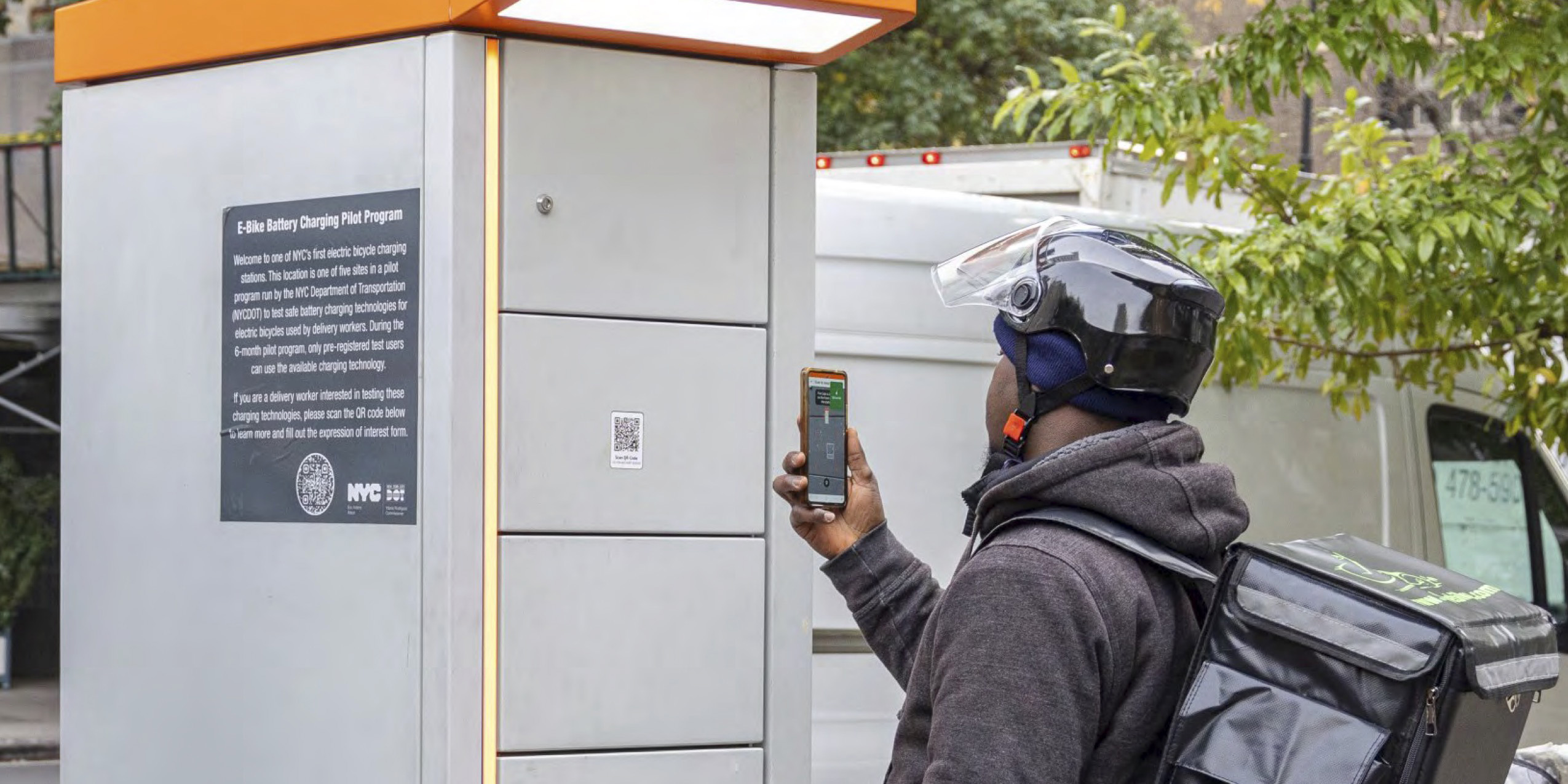
Since 2022, e-bike battery fires across New York City have killed 30 people and caused more than 900 fires. Most of those fires started at home, where delivery workers charge their batteries overnight. NYC DOT came to Community Board 2 Tuesday with a plan to change that with a battery-swapping program.
The agency is proposing a network of 25 publicly accessible battery-swapping cabinets across high-delivery neighborhoods, funded by a $3 million NYSERDA clean mobility grant. The cabinets let workers swap a dead battery for a charged one in under a minute, moving charging from apartments and onto regulated, fire-safe sidewalk infrastructure.
Two sites in Long Island City are on the proposed list. The city is accepting public feedback on proposed locations through July 31. The program hopes to begin construction in early 2027, with cabinet installation beginning late 2027/early 2028, and the program launching in two years.
New York City has more than 65,000 delivery workers, and demand for their services keeps growing. Every order placed on DoorDash, Uber Eats, or Amazon depends on someone on an e-bike making the last mile. Most of those workers charge their batteries at home, in apartments, overnight.

The cabinets are certified to UL safety standards, weather- and theft-proof, and equipped with fire containment features. Each unit holds up to 16 batteries and can serve up to 100 workers per day. The swap takes less than a minute: a worker scans a QR code, selects a charged battery, switches it out, and rides away. The system continuously monitors battery health and only dispenses certified batteries.
At 25 locations, DOT estimates the network could support roughly 2,500 swaps per day. The program is designed to be financially self-sustaining through membership fees charged by the selected vendor, who will also be responsible for maintenance and cleanliness of each site.


proposed long island city sites
Two Long Island City locations are on the proposed list. Site 27 is on 44th Drive at Jackson Avenue, on the north block in front of City Chemist and Sweetgreen. Site 28 is on 11th Street at 46th Road, on the southeast corner.
DOT identified 50 candidate locations citywide before narrowing to a final 25. Sites were prioritized near restaurant clusters, high-delivery zones, bike lanes, major streets, and wider sidewalks. Delivery workers who participated in the 2024 pilot also suggested locations, and some of those made the list.
Every proposed site had to clear a long list of physical requirements: distance from bus stops, fire hydrants, tree pits, standpipes, mailboxes, benches, newsstands, and streetlights, among others. DOT also weighed pedestrian flow, bike flow, visibility for drivers, proximity to schools and religious institutions, flood zones, and whether the location fell within a historic district.
The cabinets must maintain a clear path on the sidewalk at all times, stay at least 10 feet from fire hydrants and crosswalks, and remain clear of building entrances.
FEEDBACK SOUGHT
DOT is currently accepting public feedback on all 50 proposed locations. Residents can weigh in on the sites under consideration, suggest locations that were missed, or flag concerns about specific sites. Feedback submitted by July 31 will be used to finalize the list of 25 installation locations.
Submit feedback at nycdotprojects.info/content/submit-your-feedback.
Selected slides from dot presentation


More Details
- Public E-Bike Charging (PEC) Program
- Share Your Feedback on Proposed E-Bike Battery Swapping Cabinet Locations
- Press Release: NYC DOT Report Hails Success of Public E-Bike Battery Charging Pilot, Agency Outlines Next Steps
- PDF report: Safer Charging, Safer Deliveries. Lessons from NYC DOT’s Public E-Bike Charging Pilot
- Listen: City Hall Deliverista mobility hub: Man Man & Gustavo
- Listen: Contentious Curbside EV Charging in Urban Neighborhoods
editorial
Our take
This program should happen, and it should happen faster than 2028.
Delivery workers power a massive piece of this city’s daily economy. Meals, packages, and prescriptions that show up at your door come on the back of someone on an e-bike who has no safe place to charge it. Charging in apartments is an infrastructure gap that this program closes.
The two LIC sites are well-chosen. DOT noted that both are adjacent to existing bike lanes with additional hardening and separation from traffic. This matters; cars hit everything. We advocate for DOT to harden the area around the cabinets with bollards and physical protection. This isn’t optional.
One concern is worth naming: every cabinet installed on a sidewalk is taking up sidewalk space that pedestrians no longer have. Our public realm is finite. We already give an enormous share of it to vehicles: while parked, while moving, and everything in between. Adding infrastructure for e-bike charging is the right call, and where possible they should be in the parking lane, not on the sidewalk.
This shouldn’t be a reason not to install this much-needed infrastructure, but going forward vehicle things should stay where the vehicles are.
I interviewed designer ManMan Mancilla and Deliverista Gustavo Ajche about the City Hall mobility hub in 2024, and what Gustavo said has stayed with me:
“If it’s in the street, it’s not going to be in my apartment, it’s not going to be in somebody else’s house or building.”
That is the whole argument, in one sentence.
Build it.
Listen to that conversation at jwp.news/city-hall-deliverista-mobility-hub-man-man-gustavo or below:
The author is a member of Queens Community Board 2. The views and opinions expressed in this article are solely the author’s own and do not represent the position of the Community Board or any of its members.


